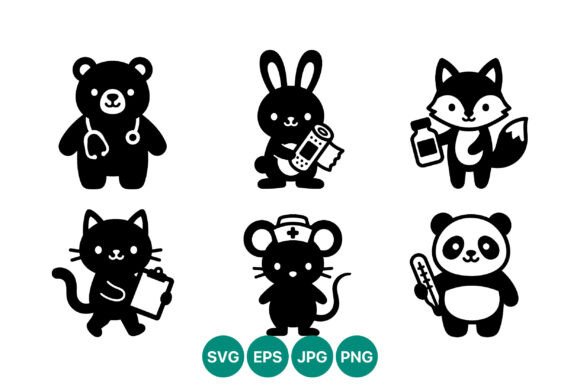
Medical Animals Vector Set
A Designer’s First Look: Clean, Kind, and Quietly Clever
Opening the Medical Animals Vector Set, I immediately felt that familiar little lift—the kind you get when a design lands just right. Not flashy, not cutesy-overload, not clinical or cold. Six black-and-white line-art animals, each wearing a gentle, purposeful medical motif: bear with stethoscope, rabbit wrapped in bandages, fox holding a medicine bottle, cat with clipboard, nurse mouse, panda with thermometer. The lines are confident but soft—no jagged edges, no unnecessary flourishes. It’s illustrative, not cartoonish; friendly, not infantile. That balance matters—especially if you’re stitching for real people who’ll wear, gift, or live with this design daily.
This Isn’t Just Decoration—It’s Storytelling on Fabric
I recently prepped a custom embroidered tote bag for a pediatric clinic’s front desk staff—a “thank you” gift for their volunteer team. They wanted warmth, professionalism, and subtle humanity—not logos, not slogans. The Medical Animals Vector Set fit like a glove. I chose the nurse mouse (tiny but expressive) and the panda with thermometer, scaled them to 3.5" wide, and stitched them side-by-side on natural canvas. The result? Instant recognition, zero confusion, and a quiet sense of care. Customers didn’t see “embroidery”—they saw kindness made tangible. That’s the quiet power of this set: it communicates empathy without saying a word.
Where It Shines—and Where You’ll Want to Pause
The Medical Animals Vector Set excels in projects where clarity, charm, and calm matter most:
- Small-batch apparel: Sweatshirt chest pockets, baby onesie sleeves, apron corners—its clean linework translates beautifully at 2–4" scale, especially on medium-weight cotton or linen blends.
- Patches & applique designs: Each animal reads clearly as a standalone motif. Perfect for embroidered patches sewn onto scrubs, lab coats, or backpacks—no visual noise, no competing details.
- Nursery decor & baby embroidery: The rabbit with bandages or panda with thermometer feels tender, not clinical—ideal for crib blankets, pillow covers, or milestone cards.
- Holiday or sympathy gifts: A tea towel embroidered with the bear and stethoscope makes a thoughtful hostess gift for a new nurse. A linen pouch with the fox and medicine bottle? A gentle, meaningful gesture for someone recovering.
- Etsy listings & boutique branding: As digital embroidery files or printable mockups, these illustrations lend instant cohesion to a shop’s aesthetic—especially for craft businesses focused on wellness, caregiving, or gentle professions.
Real Embroidery Realities: What to Watch For
This isn’t a plug-and-stitch file—it’s a thoughtful illustration set that asks for thoughtful execution. Here’s where attention pays off:
- Hoop size & detail density: The nurse mouse’s tiny clipboard or the panda’s thermometer dial may push limits on very small hoops (under 3"). Test stitch one animal first—check whether fine lines hold up in satin stitch or running stitch.
- Fabric texture & stability: On textured fabrics (like terry cloth towels or bouclé sweatshirts), simplify stitch types—lean into outline + minimal fill. Avoid dense fill stitches in curved areas like ears or tails unless you’ve stabilized well.
- Dark or stretchy fabric: Black-and-white vectors rely on contrast. On charcoal or navy fabric, white thread will pop—but test thread color contrast before committing. On knits, use cutaway stabilizer and avoid sharp directional changes in the line paths.
- Curved surfaces & layered garments: Caps or baby beanies need careful digitizing. The original vector lines are elegant—but curves distort easily. If turning this into a machine embroidery design, consider slightly widening key strokes (e.g., stethoscope tubing, thermometer glass) for legibility.
- Wash durability: These motifs often land on items meant to be laundered regularly—think kitchen towels, baby bibs, or scrub tops. Confirm stitch density isn’t so low it frays, nor so high it stiffens delicate fabrics.
How It Elevates Your Finished Product—Beyond the Stitch
When customers see a well-executed Medical Animals Vector Set motif on a handmade product, they don’t just register “cute animal.” They register intention. Thoughtfulness. Craftsmanship. That perception lifts perceived value—whether you’re pricing a $28 embroidered pillow cover or a $95 custom scrubs set. It also builds trust: healthcare-adjacent buyers respond to authenticity, not cliché. This set avoids clipart energy. It feels designed—not assembled.
For Etsy sellers and small shop owners, that distinction is commercial oxygen. Listings with these motifs consistently earn higher engagement in search terms like “nurse gift,” “pediatric embroidery,” or “medical professional present.” Why? Because the design supports the story—not distracts from it.
Designer Notes You’ll Actually Use
Before digitizing or stitching:
- Test the Medical Animals Vector Set on scrap fabric matching your final project’s weight and stretch.
- Check how line thickness holds up in your chosen stitch type—running stitch for outlines, satin for small fills, minimal fill stitch for bodies.
- Review all six animals in black-and-white mockups against light and dark backgrounds. Does the fox’s medicine bottle remain legible on heather grey?
- Confirm stabilizer choice—especially for thin or loosely woven fabrics. A lightweight tear-away may not suffice for crisp line definition.
- If selling finished products or digital embroidery files, verify licensing terms. As Graphics and Illustrations, usage rights vary—don’t assume commercial embroidery rights are included.
- Ask yourself: does this serve the person wearing or gifting it? If yes—you’re using the Medical Animals Vector Set the way it was meant to be used.
Final Thought: Design With Purpose, Stitch With Care
The Medical Animals Vector Set won’t shout. It doesn’t need to. Its strength lies in its restraint—in how quietly it says, “I see your work. I honor your care.” That resonance carries through every embroidered patch, every personalized gift, every small shop product that lands with meaning instead of noise. Used thoughtfully, it’s more than a design asset. It’s a small act of recognition—stitched, shared, and worn with pride.